

Crossing the River bridges the information gap between China’s entrepreneurial ecosystem and the West -- translating, summarizing, and contextualizing the ideas, strategies, and stories that Chinese founders and investors are reading right now, but that rarely make it into English.
This post is a translated summary of Wei Lai Ni Shou Yu Li Bin Te Ding Ji Xiao Mu Biao Gu Fen Ji Li (”NIO Proposes Performance-Gated Share Grant for Li Bin -- Full Vesting Requires Net Profit Above US$6 Billion”), published March 10, 2026 by Sina Finance. Li Bin is #18 on our Crossing the River Top 25 Chinese Founders list.
The headline
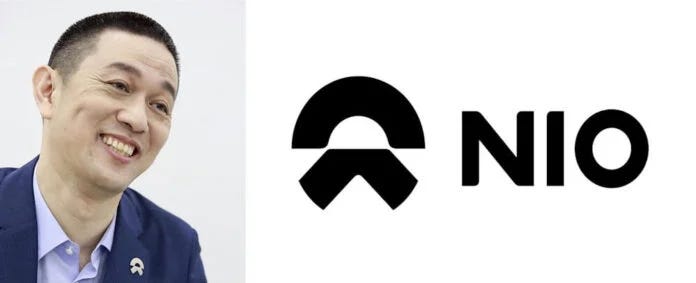
NIO’s board has approved a 2026 share incentive plan granting founder, chairman, and CEO Li Bin approximately 248 million restricted shares -- worth roughly HK$9.5 billion (~US$1.2 billion) at the time of announcement. The shares vest in ten equal tranches, each tied to specific market cap and net profit milestones. Full vesting requires NIO to simultaneously reach a market cap of US$120 billion and net profit of US$6 billion. The plan took effect March 6, 2026 and has a twelve-year window to run.
If those numbers sound familiar, they should. This is Elon Musk’s 2018 Tesla compensation structure, imported wholesale into China’s EV industry.
How the milestones work
The plan splits into two parallel tracks. Either track can unlock a tranche independently -- Li Bin does not need to hit both at once for individual tranches, only for the final full vesting.
Market cap track -- one tranche (one-tenth of shares) unlocks each time NIO’s US-listed market cap crosses:
US$30 billion
US$50 billion
US$80 billion
US$100 billion
US$120 billion
Net profit track -- one tranche unlocks each time NIO’s annual net profit crosses:
US$1.5 billion (approx. Y10.9 billion)
US$2.5 billion (approx. Y18.1 billion)
US$4 billion (approx. Y29 billion)
US$5 billion (approx. Y36.2 billion)
US$6 billion (approx. Y43.5 billion)
When NIO simultaneously clears US$120 billion in market cap and US$6 billion in net profit, the final tranche triggers and the plan is complete.
What the numbers mean in context
At the time of announcement, NIO’s Hong Kong-listed shares closed at HK$38.14 (~US$4.90), implying a total market cap of roughly HK$93.9 billion (~US$12 billion). The first market cap milestone -- US$30 billion -- would require a 2.5x increase from that level. The final milestone of US$120 billion is a 10x.
NIO is not yet profitable. The company has never posted a full-year net profit. The lowest profit milestone in the plan -- US$1.5 billion -- does not just require profitability, it requires NIO to reach a level of profitability that most Western EV startups outside Tesla have never achieved.
The plan is designed to be very hard to achieve. That is the point.
Why this structure, and why now
The Musk 2018 package was a landmark in corporate compensation history: no salary, no cash bonus, no guaranteed payout of any kind -- just an all-or-nothing bet on whether Musk could build Tesla into a genuinely world-scale company. The plan was widely mocked at the time. By 2022, with Tesla’s market cap briefly touching US$1.2 trillion, it had produced the largest single CEO payout in history.
The structural logic is straightforward: align the CEO’s financial outcome precisely with shareholder outcomes. If the milestones are not hit, no shares vest and the CEO receives nothing beyond any base salary. If the milestones are hit, shareholders have already made many multiples of whatever the CEO earns.
NIO’s version applies the same logic. Analysts quoted in the announcement noted that the plan is designed to “bind CEO incentives with the company’s strategic objectives at a deep level, motivating leadership to achieve sustainable profitability improvement and value growth in fierce market competition, thereby maximizing the long-term interests of all shareholders.”
The timing matters. NIO has survived two near-death experiences -- a liquidity crisis in 2019 that required a state-backed rescue, and a brutal price war in 2023-24 that forced deep restructuring. Li Bin personally led both recoveries. The board is now betting he can take NIO all the way to global scale, and structuring his compensation to ensure his incentives stay aligned for the next decade-plus.
NIO’s momentum heading into the plan
The announcement came alongside NIO’s Q4 2025 results, which showed the company’s strongest numbers to date:
Full-year 2025 deliveries: 326,028 vehicles, up 46.9% year-on-year
Full-year 2025 revenue: Y87.5 billion (~US$12.1 billion), up 33.1% year-on-year
Full-year 2025 gross profit: Y11.9 billion (~US$1.6 billion), up 83.5% year-on-year -- a record
Q4 2025 operating profit: Y1.25 billion (~US$172 million)
Q4 cash reserves: Y45.9 billion (~US$6.3 billion), up nearly Y10 billion quarter-on-quarter
For Q1 2026, NIO guided for deliveries of 80,000-83,000 vehicles (up 90-97% year-on-year) and revenue of Y24.5-25.2 billion (~US$3.4-3.5 billion, up 103-109% year-on-year). Those are not the numbers of a company in distress -- they are the numbers of a company that has turned a corner and is beginning to scale.
The deeper story: Li Bin as a founder
It is worth pausing on what Li Bin has actually done. He founded NIO in 2014 as a luxury EV startup in a market where no Chinese brand had ever successfully sold a premium car. He built a battery-swap network from scratch -- now over 2,700 stations -- that is the largest standardized EV infrastructure project in the world. He survived a 2019 funding crisis so severe that NIO’s survival was genuinely uncertain, ultimately securing a government-backed rescue from Hefei. He launched a mass-market sub-brand (ONVO) to compete at lower price points while keeping NIO premium.
He has also been one of China’s most publicly visible founder-CEOs -- doing long-form interviews, engaging directly with customers on social media, and maintaining an unusual degree of personal transparency about the company’s challenges. When NIO was struggling in 2023, Li Bin appeared at delivery events and held town halls. He did not hide.
The compensation plan is a board saying: we believe this founder has what it takes to build a global company, and we are structuring his incentives to make sure he is still here and still hungry when we get there.
The Musk comparison, honestly assessed
The structural parallel to Musk’s 2018 plan is real and deliberate. But there are meaningful differences worth noting.
When Tesla’s board designed Musk’s package, Tesla had a market cap of roughly US$59 billion. The final milestone -- US$650 billion in market cap -- was 11x from that point. NIO’s plan asks for a 10x from US$12 billion to US$120 billion. The proportional ambition is similar.
But NIO operates in a far more competitive domestic market than Tesla did in 2018. BYD, Li Auto, AITO (Huawei), XPeng, Zeekr, and dozens of others are all competing aggressively in the segments NIO plays in. NIO’s battery-swap technology is a differentiator, but it is also a capital-intensive infrastructure bet that requires continued investment. And NIO is still pre-profitability, while Tesla was already generating positive cash flow when its 2018 plan launched.
None of that makes the bet wrong. It makes it genuinely difficult -- which is exactly what a well-designed performance compensation plan should be.
Crossing the River is an independent newsletter focused on Chinese entrepreneurship and innovation. We translate and contextualize the ideas that Chinese founders, investors, and operators are actually reading -- in Chinese -- and make them accessible to a global audience. If you found this useful, consider sharing it with someone who should be paying more attention to what is happening in China.